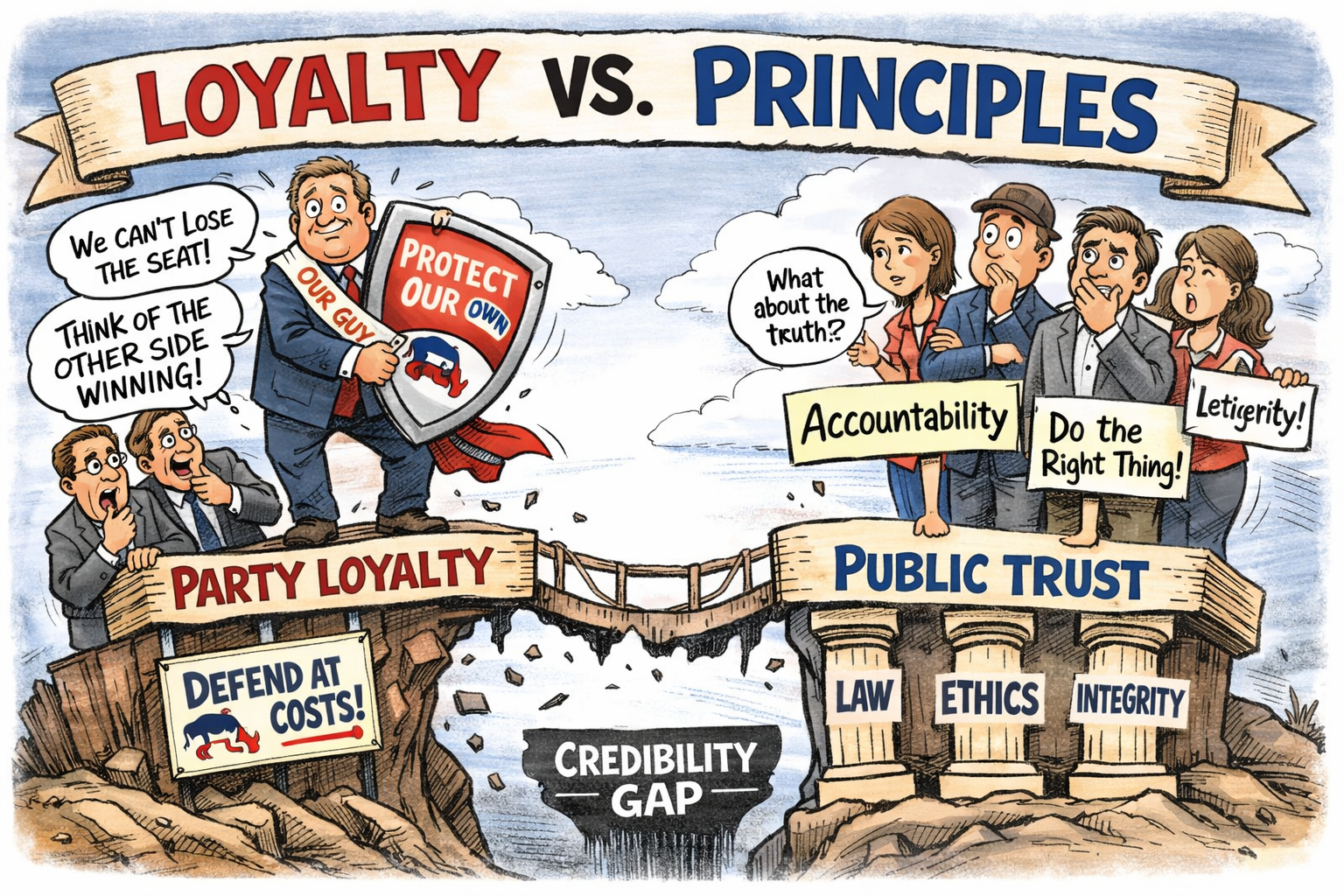
Political parties play an important role in a healthy democracy. They recruit candidates, help them get elected, and advance shared policy goals. But that role carries responsibility. When party loyalty is placed above public trust, ethical standards, or the rule of law, the party risks undermining the very principles it claims to defend. The following points outline where that line should be drawn and where our party has too often missed it.
Political parties exist to:
• Recruit candidates
• Help them get elected
• Promote shared policy goals
Political parties do not “own” the officeholder.
Once elected, that official’s primary obligation is to:
• The public
• The law
• Ethical standards
Party loyalty ends where public trust begins.
No automatic obligation:
• A political party is not morally or legally obligated to support an elected official facing recall or ethics violations.
• In many cases, there is a moral obligation not to support them.
• Fear that the “other side” might win the seat is often used to justify continued support.
A principled party should assess in regards to recalls:
• Whether the recall is about policy disagreement or misconduct.
• Whether public trust, law, or ethics were violated
• Make support conditional, not unconditional
Helping someone get elected creates no moral debtthat overrides:
• Law, Ethics Voters’ rights
• A party’s highest obligation is to the public interest, not protecting its own.
Overall – This is where our party misses:
If a political party helps get their people elected, should their be an obligation to support them if they come under recall or other issues such as ethic violations etc.
Short answer: no—there should not be an automatic obligation, and in many cases there is a moral obligation not to support them.
The Conservative Perspective:
From a conservative viewpoint:
- Character matters
- Rule of law matters
- Power must be constrained—even when it’s your own
A conservative party that excuses unethical conduct for political convenience stops being conservative and becomes transactional. The big question for fellow conservatives – is it worth the risk of having a community disgusted with the party. To have the party brand tainted to the point it takes years to recover or is it better to stand on principle and integrity so that the community is proud of our party.
When a Political Party Strays:
Would recruiting more community members to become PCP’s help in building trust and transparency?
Yes, recruiting more community members to become PCPs (Precinct Committee Persons) can be one of the most effective ways to rebuild trust and transparency if it’s done intentionally and correctly. It’s not a silver bullet, but it’s a powerful structural fix in a small community.
It is critical that new PCPs clearly understand why they are serving in this role. One of their primary responsibilities is to ensure that every potential candidate is thoroughly vetted and held to the highest standards. This has become one of the most pressing issues facing our community today. PCPs must be actively engaged and willing to demand integrity, competence, and accountability from those seeking to represent us, because it is our community that will ultimately be affected by the actions of these individuals.
Bottom Line:
In a small community, a political party survives on trust, restraint, and service. When it strays, the most effective response is accountability without bitterness, always keeping the community stronger than the party.
Conclusion:
A political party’s duty is not to shield its own, but to uphold the public trust. When loyalty replaces principle, credibility is lost. The path forward is clear: enforce standards, welcome accountability, and strengthen the party through transparency and community involvement. Only a party that puts principles before power can earn and keep the trust of the people it serves. Locally, our political party needs to learn its boundaries and stay within them.
Some background: I do not consider myself a moderate. I am a staunch believer in conservatism who places principle and honesty at the very top of my priorities. With honesty, a principled conservative can never truly lose and will always have the community behind them.
The community may not always agree with every decision, but honesty and transparency will guide them through the reasoning behind those decisions. I have said this many times and will continue to do so: when facing any controversial decision, it is essential to seek out community support. This is where many have failed, I hope they learn.