This is Part II: Part I is entitled, “A Membership in a Political Party or a Philosophy?” Part I dealt with political party versus political philosophy.
Part II – Introduction
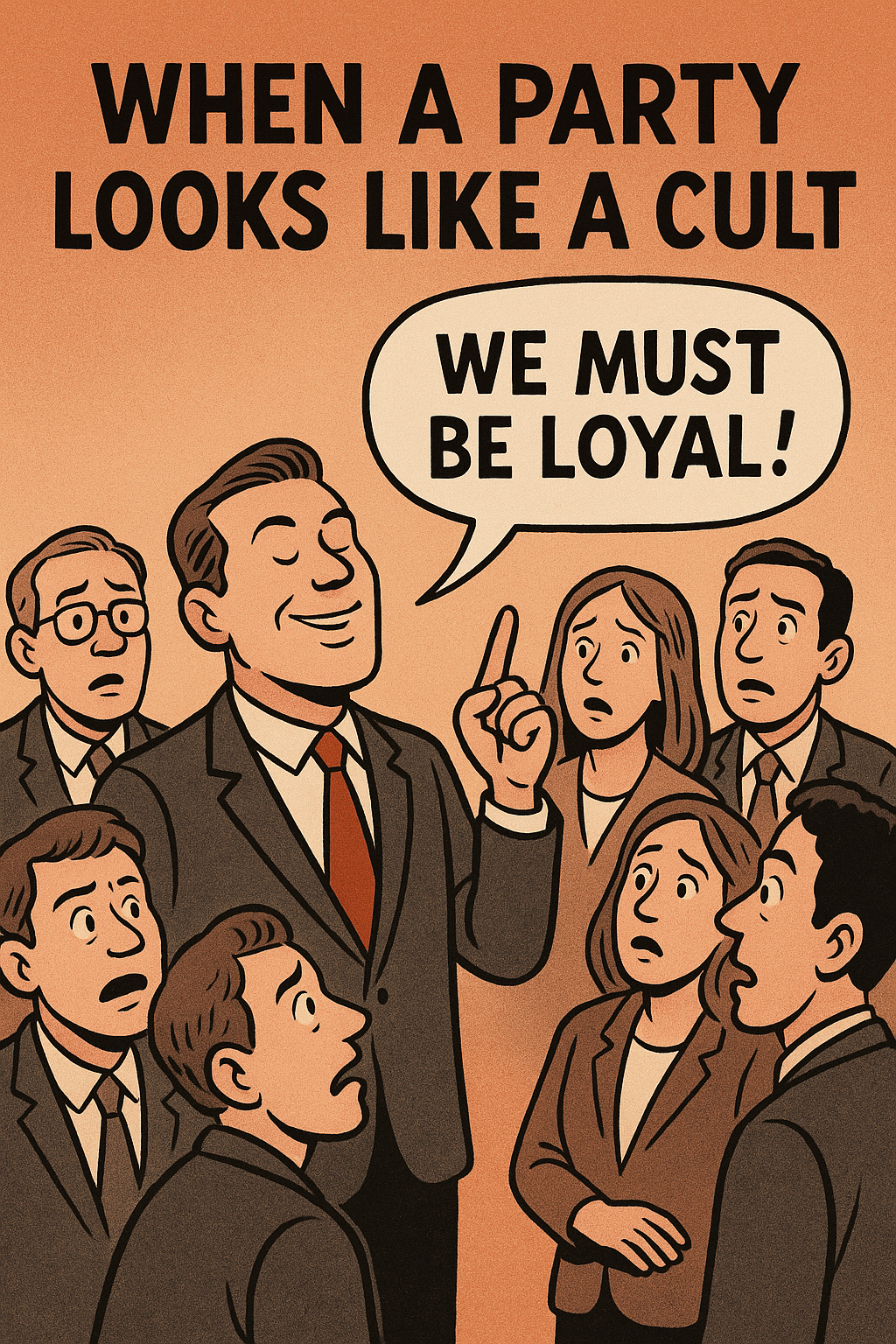
Political parties naturally attract people who share similar beliefs, but sometimes the internal culture shifts from healthy teamwork to something more rigid and unhealthy. When loyalty becomes more important than honesty, and group identity replaces critical thinking, a party can begin taking on patterns that resemble cult-like behavior. It raises the question of whether any of these traits show up in the Josephine County Republican Party. The following warning signs highlight how this transformation can occur. Let’s take a closer look:
- Blind Loyalty to Leaders
• Pattern: Members defend leaders no matter what, even when evidence shows wrongdoing. Criticism is treated as betrayal.
• Example: Social media accounts repeatedly attacking anyone questioning the party, while praising the leader’s every action as flawless. - “Us vs. Them” Mentality
• Pattern: Outsiders, including other party members who dissent, are labeled enemies or traitors.
• Example: Party messaging frames opponents not just as political rivals but as immoral or dangerous, creating fear or hatred of anyone outside the group. - Punishing Independent Thought
• Pattern: Questioning party strategy or policies leads to social ostracism, ridicule, or threats of being “kicked out” of the community.
• Example: A member who posts critical opinions online is removed from party events, or publicly called a traitor. - Hero-Worship of Leaders
• Pattern: Leaders are framed as morally superior, infallible, or uniquely “chosen” to guide the group.
• Example: Speeches or posts consistently claim the leader “knows what’s best for everyone,” and followers repeat this as unquestionable truth. - Sacrificing Personal Autonomy
• Pattern: Members are pressured to dedicate extreme amounts of time, money, or social capital, often framed as a moral obligation.
• Example: Donations, constant activism, or abandoning personal relationships are framed as necessary for the cause. - Suppression of Dissent
• Pattern: Disagreements are punished or ignored; dissenters are attacked emotionally or socially.
• Example: Online forums delete posts that suggest moderation or compromise; members who speak up are labeled disloyal.
Bottom Line:
It’s not about political ideology any party, left or right, can show these patterns. The red flags are in how a party treats members, dissent, and information, not the ideas themselves. A political party doesn’t have to exhibit all these traits to be concerning, just a few, especially if they reinforce each other, can create a cult-like environment. These descriptions may prompt the question of whether similar traits exist within our Josephine County Republican Party. There are moments when I’ve wondered whether it operates as a political organization, a social circle, or something more closed-off.
Conclusion:
These behaviors aren’t tied to any single ideology. They can emerge in any group when loyalty is valued above accountability and when questioning is treated as disloyal. A healthy political organization encourages open dialogue, critical thought, and transparency, because the strength of a party comes not from conformity, but from its ability to listen, adapt, and remain grounded in principles rather than pressure.