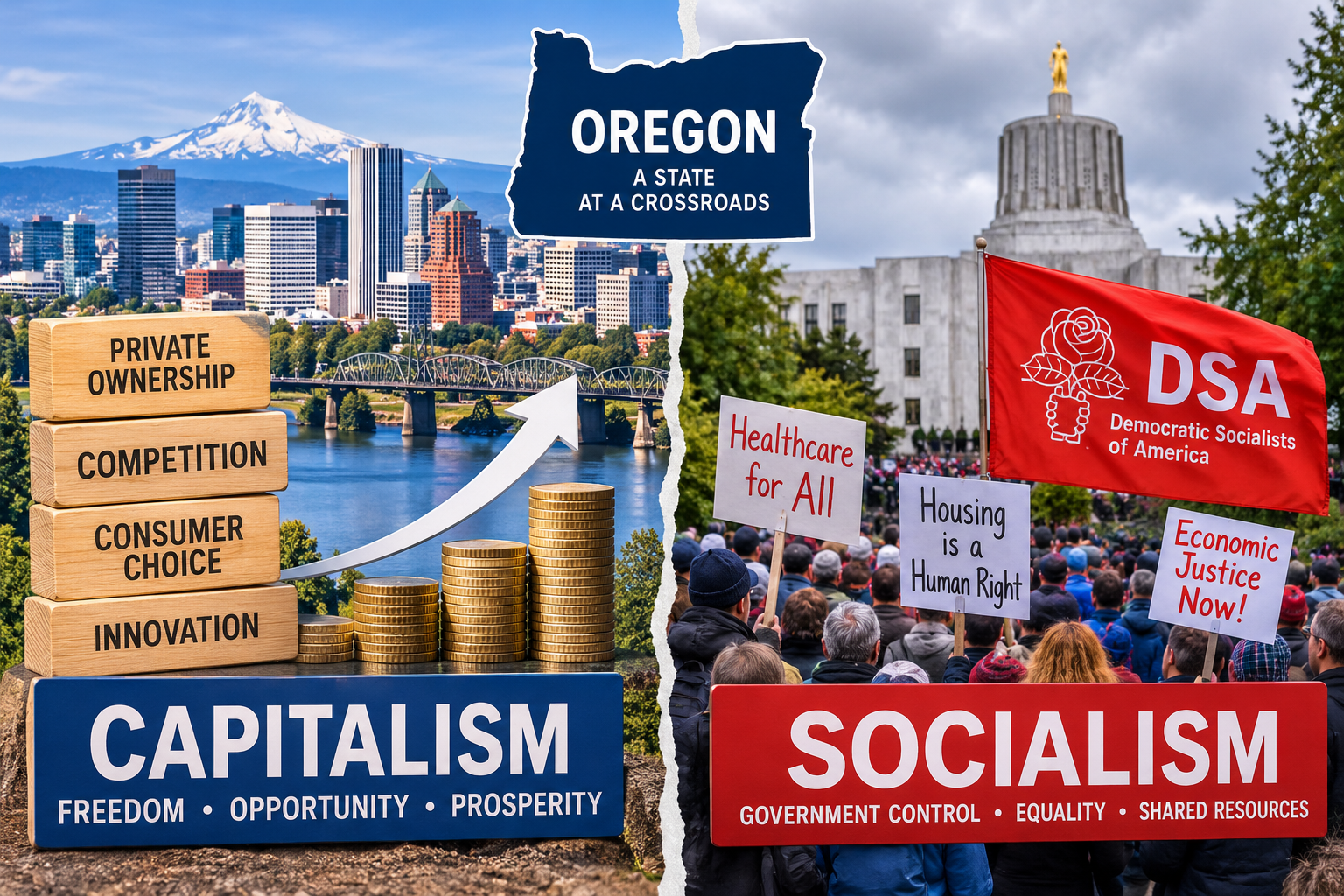
Capitalism and socialism take very different approaches to running an economy. Capitalism relies on private ownership, competition, and consumer choice. Socialism places major industries and economic decisions under government control. The historical record favors capitalism for creating prosperity, innovation, and individual freedom, though no system is perfect. Government-run services often face weaker incentives to control costs, improve service, and respond to customers.
Oregon is showing why this debate matters. Democratic Socialists are expanding beyond Portland through local organizing, candidate recruitment, and down-ballot elections. Their influence is growing in Salem, Eugene, Bend, and the Medford area.
The Basic Difference
- Capitalism: Individuals and businesses own property, companies, land, and other productive assets. Prices, wages, and production are mainly shaped by supply, demand, and competition.
- Socialism: The government or public sector owns or controls major industries and productive resources. Government planners often decide what is produced, how much it costs, and how resources are distributed.
- Main question: Capitalism asks how individuals and businesses can best create wealth and serve customers. Socialism asks how government can organize production and distribute resources for collective goals.
Why Capitalism Works
- It rewards effort and innovation. People have a reason to work, save, invest, and take risks because they can keep the rewards of success.
- It responds to customers. Businesses that offer better products, lower prices, or better service tend to succeed.
- It creates opportunity. Individuals can start a business, change jobs, invest, and build wealth without needing approval from a central planning agency.
- It limits government power. When government does not control most jobs, housing, food, and industry, citizens have more independence from the state.
Examples of Socialist Countries
- Venezuela: Under Hugo Chávez and Nicolás Maduro, the government nationalized industries, imposed price controls, seized private property, and expanded state control over oil and other key sectors. The result included shortages, hyperinflation, mass emigration, and a severe humanitarian crisis.
- Cuba: Cuba’s constitution describes its economy as socialist, with government ownership and central planning. The country has achieved some gains in literacy and health care, but decades of state control have also produced shortages, limited economic opportunity, and dependence on outside support.
- North Korea: One of the most extreme examples. The government controls nearly all economic activity, restricts travel and information, and maintains a highly repressive one-party system. The result has been chronic poverty, food shortages, and isolation from the world economy.
Oregon’s Movement
- Democratic Socialists are building influence outside Portland. DSA chapters operate in Portland, Salem, Eugene, and Bend, with an organizing committee in the Medford area.
- Local elections matter. The DSA is building power through candidate recruitment, campaign support, and grassroots activism rather than focusing only on statewide races.
- The strategy is working. DSA-backed candidates have won Portland council seats and races in two Oregon House districts. In McMinnville, DSA-backed candidate Richard Smith Savage narrowly led incumbent Carson Benner in a city council race, though the result was not final at the time of the report.
- The concern is gradual control. Socialist candidates may not immediately propose government ownership of every business, but each expansion of government power can move Oregon closer to socialism.
Summary
- Capitalism gives individuals and businesses the freedom to own property, compete, invest, and make economic choices.
- Socialism gives government much greater control over production, prices, jobs, and major industries.
- Oregon is moving in a socialist direction as Democratic Socialists build influence through local elections and organizing across the state.
- History shows that countries with heavy government control often face shortages, inefficiency, and reduced liberty.
- The best approach is limited, constitutional government that protects property rights and individual freedom while allowing markets—not politicians—to guide most economic decisions.
Sources
- Hoover Institution, “Capitalism Vs. Socialism”: https://www.hoover.org/research/capitalism-vs-socialism-2
- Coolidge Foundation, “Socialism Versus Capitalism”: https://coolidgefoundation.org/wp-content/uploads/2022/09/Socialism-Versus-Capitalism-Brief-FINAL.pdf
- Britannica, “American Socialism | Pros, Cons, Debate”: https://www.britannica.com/procon/American-socialism-debate
- Khan Academy, “When Capitalism is Great and Not-So-Great”: http://khanacademy.org/humanities/us-history/history-survey/us-history-survey/v/when-capitalism-is-great-and-not-so-great
- Americans for Prosperity, “Socialism vs. capitalism: What’s the difference?”: https://www.americansforprosperity.org/blog/socialism-vs-capitalism-whats-the-difference/amp/
- Randy Stapilus, “Democratic Socialists Build a Foothold Beyond Portland,” November 12, 2026.https://oregoncapitalchronicle.com/2026/11/12/the-seeds-of-democratic-socialism-in-oregons-wine-country/