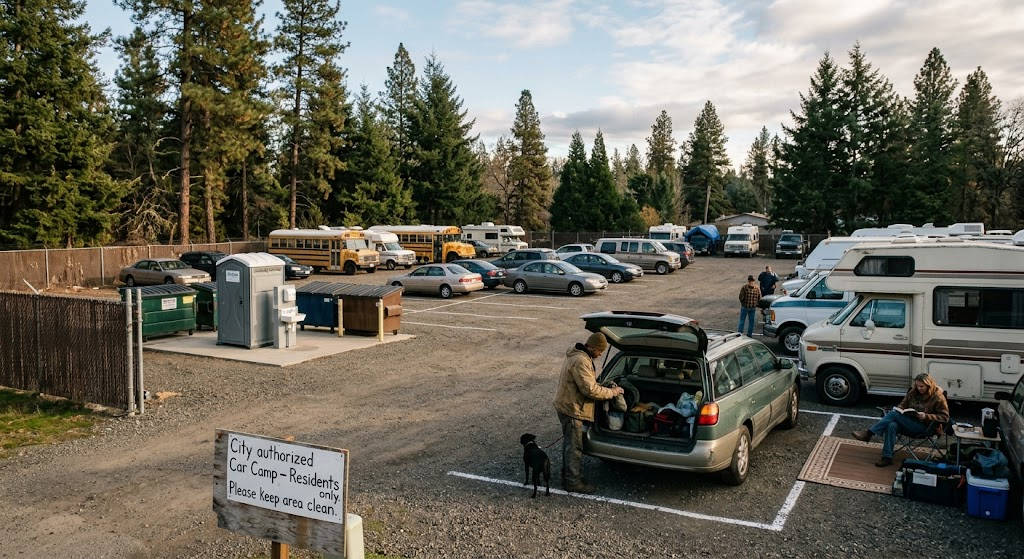
City and county leaders in Grants Pass, Oregon, recently met to explore a joint proposal for a managed car camping site on the city’s outskirts to address local vehicle residency. Below is a breakdown of the core proposal and the potential risks discussed.
- Car Camping Zone Idea: Local leaders discussed establishing a designated lot on the city’s outskirts for approximately 30 to 40 vehicles housing unhoused residents.
- Proposed Structure: The county would supply the land, local police and sheriff departments would provide security, and operational duties would be handed off to a nonprofit organization.
- Funding Strategy: Joint involvement between city and county governments would make the project eligible for state grants, which nonprofits cannot directly use to acquire property.
Potential Risks
- Blight & “Scrap Yard” Deterioration: Abandoned, broken-down, or non-operational vehicles could be permanently left behind, effectively turning the property into an unregulated salvage yard.
- Increased Homeless Migration: Opening a managed lot could attract unhoused motorists from surrounding regions, significantly growing the local population beyond original capacity.
- Environmental & Sanitation Hazards: Concentration of vehicles carries risks of hazardous fluid leaks (oil, fuel, coolant), improper waste disposal, and severe trash buildup.
- Indefinite Timelines & Scope Drift: Without clear exit strategies, the site could become a permanent fixture rather than a temporary solution, straining long-term local resources.
- Liability & Enforcement Challenges: Managing low-barrier sites creates potential legal liability, safety concerns, and friction over monitoring responsibilities between law enforcement and nonprofit operators.